
From Regime Survival to Reconstruction: External Actors in Syria, 2011–2026
Key Notes
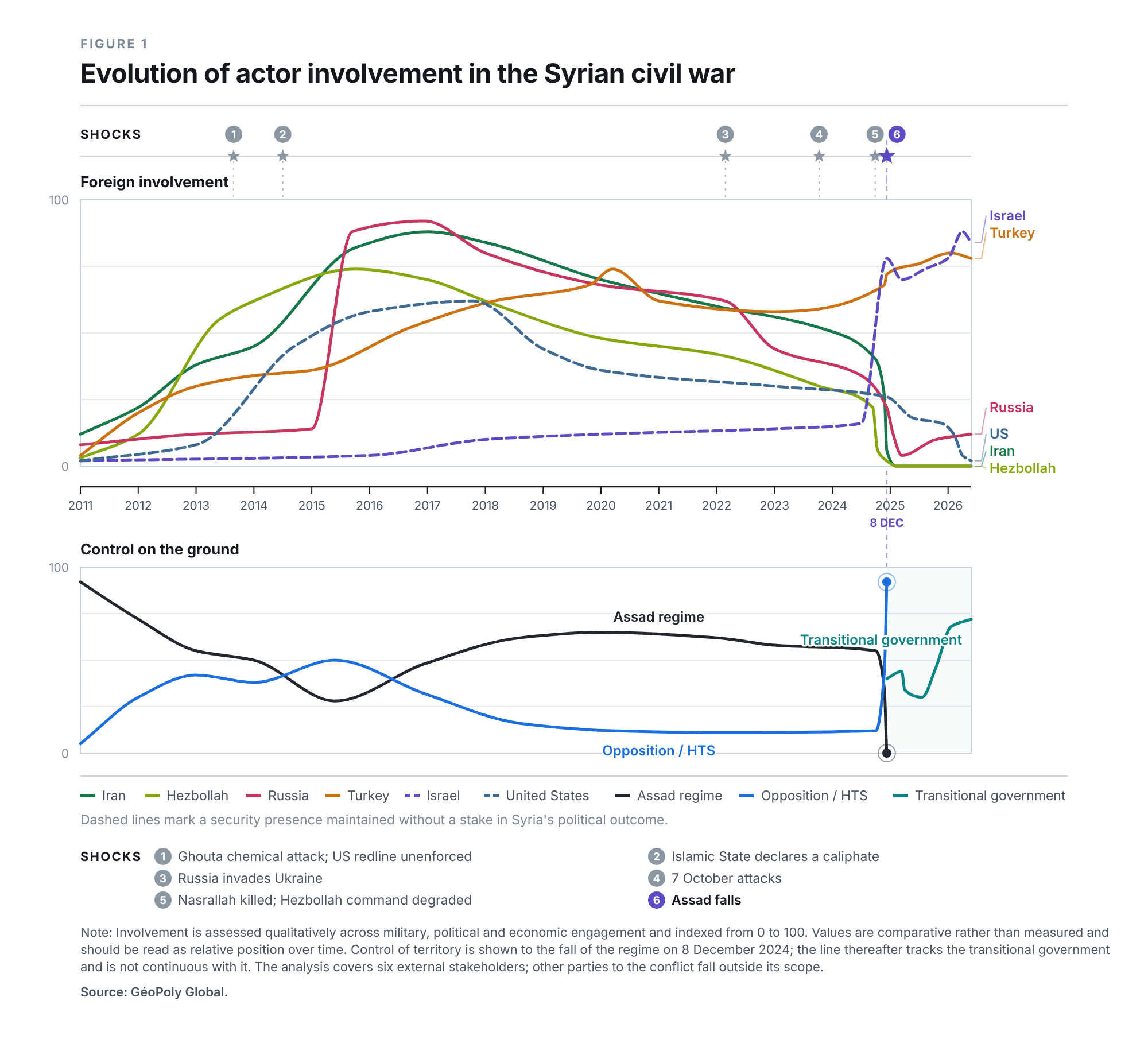
Assad survived for as long as Moscow and Tehran had capacity to spare. Russia provided airpower, military coordination and diplomatic cover, and Iran and its allies provided most of the ground presence. When the war in Ukraine and Israel’s campaign against Hezbollah used up that capacity, the regime fell by late 2024.
The new government’s stability probably depends on outside backers in the same way, so events far from Syria act as leading indicators for Damascus. Israel and Turkey expanded their presence after Assad for security and political reasons, and may not be the ones that pay to rebuild Syria. The United States moved in the opposite direction, drawing down its forces while retaining influence through its control of Syria’s access to international markets.
Recovery depends on the state rebuilding its institutions and holding a monopoly on arms. With US sanctions lifted between 2025 and 2026, foreign investment could flow into Syria. Turkey’s role depends on border security and the Kurdish issue, the Arab States’ on budgets strained by regional conflict, while Russia’s is likely to stay selective and centred on its military base. Iran, by contrast, has been largely shut out after Damascus cut ties with the IRGC and its allied militias, which ended Tehran’s land corridor to Hezbollah.
Assad’s Survival and Fall
The Syrian Civil War, which began in 2011 following widespread protests, developed into an armed conflict that placed the survival of the Assad regime under sustained pressure until it fell in 2024. External intervention by Iran and Russia became central to the trajectory of the war, with each actor contributing distinct forms of military, political, and strategic support. Rather than attributing outcomes to a single actor, Iran and Russia played different but complementary roles at different stages of the conflict. An analytical assessment of these roles provides a basis for projecting how influence may evolve in the post-conflict phase, particularly in the context of reconstruction.
Iran: The construction and persistence of the Syrian-Iranian alliance since 1979 has remained a notable feature of Middle East affairs, especially when one takes into consideration the volatility of alliances in the Middle East. Syria has functioned as a key component of Iran’s regional strategy, serving as a corridor linking Iran to allied actors, including Hezbollah in Lebanon. This relationship has been shaped by overlapping geopolitical and ideological priorities, including opposition to Western influence and support for regional partners. As a result, Syria has remained central to Iran’s broader regional posture.
Russia: Russia’s intervention was driven by a combination of regional and global considerations. Maintaining access to the Tartus naval facility, its only permanent base in the Mediterranean, was a key strategic objective. In addition, involvement in Syria provided an opportunity to project power and reassert influence in international affairs, avoiding the repetition of the 2011 outcome of the Libyan regime. Security concerns, including the potential return of foreign fighters to regions such as the Caucasus, also informed Moscow’s decision to intervene.
Operationally, Russia’s approach differed from Iran’s. While Iran and its proxies relied primarily on ground-based networks, Russia deployed formal military assets, coordinated directly with Syrian state institutions as well as provided diplomatic cover, for instance vetoing a UN resolution calling for a ceasefire in Aleppo, shielding the Assad regime from international pressure. The introduction of sustained Russian airpower and centralized military coordination altered battlefield dynamics. This shift enabled the Syrian government to transition from a largely defensive posture to one characterized by territorial recovery.
Key developments, including the recapture of Aleppo in 2016, illustrate this transition. Russia’s involvement, therefore, corresponds with a phase in which the conflict moved from regime preservation toward territorial consolidation.
Russia and Iran played complementary roles: Russia provided airpower, military coordination, and diplomatic support that enhanced the regime's capacity to retake and retain territory, while Iran and its allies supplied the majority of the ground presence. The regime's dependence on its outside allies grew more noticeable as Russian military engagement declined due to its involvement with Ukraine in 2022, and Iran and Hezbollah facing more limitations after 2023, including Hezbollah's need to withdraw its forces. As a result, the regime's ability to respond to challenges decreased, and attempts to strengthen its military posture were insufficient to make up for the loss of its external support networks, until its collapse in 2024.
Therefore, Syria’s path toward possible stability and reconstruction is expected to depend not only on domestic developments but also on how external actors seek to shape the country’s post-conflict future.
Stakeholder Analysis
To assess what a stable Syria might look like, it is essential to examine the external actors influencing the country’s stability and reconstruction. A stakeholder analysis can help identify these actors, assess their positions and evaluate their strategic interests and potential roles in the post-Assad period, particularly in relation to Syria’s need for sustainable, long-term reconstruction.
The main actors examined in this analysis include Russia and Iran, including Hezbollah, which supported the Assad regime, as well as the United States, Israel, and Turkey, who opposed it. Although other external actors also played significant roles in Syria between 2011 and 2024, this paper focuses on these six key stakeholders.
Following the fall of the Assad regime in December 2024, the graph below illustrates a shift in the presence and influence of external actors in Syria. Russia’s presence has decreased, partly due to the military and resource demands of its ongoing war in Ukraine. Iran and Hezbollah have experienced a significant decrease, largely because of Israeli military operations that weakened their networks and the loss of the Assad regime as a key strategic ally. Israel’s presence has increased as it has expanded military operations and sought to prevent hostile forces from consolidating power near its borders. Turkey’s presence has increased as the fall of Assad created opportunities to expand its influence over Syria’s political transition and security environment. The United States has reduced its military presence, withdrawing from its remaining positions in 2026 once the integration of Kurdish-led forces into the Syrian army removed the rationale for its partner-force mission. Its involvement has shifted toward economic and diplomatic channels, exercised primarily through the lifting of sanctions.
New Syria
The viability of post-Assad Syria highly depends on two interconnected priorities: political stability and successful reconstruction, both of which require substantial financial resources and international support. Assuming that the al-Sharaa administration’s permanence, the feasibility of this process depends on three key criteria:
1- State authority:
restore and modernize state institutions and public sector services. This is external signaling to establish trust with partners, for funds and investment.
Monopoly on arms and weapons: the state’s undisputed authority in internal and external security matters. If the state sees monopoly on arms as a priority, it will challenge local militias and illegal drug networks, which could easily spark new, local conflicts before the country can prove to the world that it is safe and on the path to credible reconstruction.
2- Reconstruction:
To evaluate Syria’s economic and geographic assets that could support reconstruction and generate revenue, three main infrastructure sectors are expected to play a major role, given their potential contributions to economic recovery: oil and gas, infrastructure development, and industry.
International assistance: Security and funding: it is more likely that once state intuitions and internal security stability are achieved, that international funders will react positively to these signals. This could lead to shifting from short term assistance to long term, sustained stability.
President al-Sharaa's willingness to cooperate with international partners remains an important factor. Recent political signaling allows us to assume that he will remain open to foreign investment, international assistance, and external partnerships.
External Partnerships
Syria’s reconstruction depends on its ability to attract external investment and establish partnerships that support economic recovery without undermining political stability. Although President Al-Sharaa has signaled willingness to engage with international partners, the extent of cooperation would vary depending on each actor’s strategic interests, security concerns and willingness to assume financial risks.
Turkey: high potential for economic and political cooperation
Turkey is well positioned to play a central role in Syria’s economic recovery because of its geographic proximity, and strategic interest in shaping Syria’s political and security environment. Cooperation could focus on rebuilding critical infrastructure and the rehabilitation of essential services. Improved Syrian-Turkish relations could also support the activation of economic networks linking Syria to regional and international markets. However, the sustainability of this partnership will depend on how the two governments address border security, Kurdish-led forces and Turkey’s military presence in parts of northern Syria. If these issues are negotiated, Turkey could become one of Syria’s principle partners in reconstruction.
United States: high potential for diplomatic and economic engagement
Washington has considerable influence over Syria’s access to international markets, financial institutions and investments. The U.S. sanctions policy has already changed substantially. For instance, the United States ended its comprehensive Syria sanctions program effective July 1, 2025, Congress repealed the Caesar Syria Civilian Protection Act in December 2025, and rescinded Syria’s designation as a State Sponsor of Terrorism on August 24, 2026, which shows that the United States could have a strong influence on Syria’s reconstruction phase.
Arab States: significant conditional potential
Arab States could contribute to Syria’s recovery through infrastructure, energy projects and private-sector investment. However, if the ongoing regional conflict places additional demands on public budgets or increased security risks, some states would probably adopt a more cautious approach. It is more likely that Damascus would seek diversified, project-specific partnerships with Arab states.
Israel: limited and security focused engagement
Cooperation with Israel is likely to remain constrained by the absence of comprehensive security arrangements and continuing disputes over territory and military activity. For instance, since Assad's fall, Israeli military operations and its expanded presence near the Golan Heights have complicated efforts to establish bilateral relations. In the near future, engagement between both countries is more likely to be focused on border security and preventing armed groups considered hostile by Israel from consolidating their presence in southern Syria than on direct reconstruction assistance. In relation to Israel, Syria could prioritize diplomatic engagement if it aims to reduce escalation risks without making reconstruction dependent on a broader political rapprochement to Israel.
Russia: conditional and selective approach
Since Moscow retains strategic interests in Syria, especially its military facility on the Mediterranean coast, it could seek to preserve access to these facilities through negotiated arrangements and maintain a role in infrastructure or commercial projects. Moscow continues to supply Damascus with crucial resources, including oil shipments and grain. However, its capacity to provide substantial reconstruction financing is constrained surrounding its current situation with Ukraine. Therefore, cooperation is likely to remain selective, centered on preserving strategic access and existing interests rather than financing Syria’s broader economic recovery.
Iran: near total withdrawal
The new leadership in Syria cut ties with the IRGC and Iranian-backed Shia militias, ending Tehran's primary Mediterranean supply and land corridor to Lebanon's Hezbollah. Al-Sharaa has maintained that Syria will remain outside the fighting unless directly attacked, prioritizing national reconstruction and border security over proxy alignments. Al-Sharaa has pivoted Syria toward relations with Turkey, Saudi Arabia, the Gulf states, and Western nations to secure reconstruction aid and sanctions relief. The decision itself could attract investments and aid in a sustainable reconstruction phase in Syria, considering Iran’s current role on the international stage.
Therefore, it is highly likely that Syria would pursue a diversified approach to external partnerships rather than rely on a single state to finance its recovery. International partners will also assess whether Syria can provide a predictable investment environment, protect infrastructure and manage public resources as well as prevent armed groups or illicit networks from undermining economic activity. Its ability to establish credible state institutions and extend legitimate security authority across the country will remain central to attracting long-term investment.
